

Microsleep remains one of the most disregarded threats in truck driving. It doesn’t make a lot of sound and is rarely felt dramatically before it occurs. A driver doesn’t “fall asleep” the same way traditionally. The brain instead, for a moment, shuts off but the driver can still have the eyes opened, the truck can go straight ahead and the hands can be held on the wheel. For drivers, this two-second sleep period could be the start of the end. Such incidents can have irreversible effects.
Drowsy driving is often the background condition that makes microsleep possible, even when the driver believes they are still in control.
With fatigue that builds up slowly and feels echasy to detect, microsleep tends to attack all of a sudden. It is a stroke of sleep deprivation, food and environmental conditions, and mental fatigue. Effectiveness of driving tests relies on many unnoticed seconds of the driver when he/she is unconscious of controlling the driving systematically. Learning and comprehending the microsleep’s mechanism, being able to identify early signs of it, and strictly adhering to break regulations are necessary for being not just awake but also safe.
Combating microsleep starts with treating the earliest warning signs as an immediate safety problem, not a discomfort to push through.
This article is a no-nonsense checklist showing you how to deal with microsleep. It consists of short action points for a driver based on the signs, some immediate actions to take, and structured rules for breaks like those used by truck drivers working for long hours, irregular schedules, and demanding delivery timelines.
What Microsleep Really Is — and Why Truck Drivers Are Susceptible to It

Microsleep is not something to choose or an exhibition of laziness rather; it is a neurological reaction. In the case of a sleep-deprived brain it forces a shutdown that can go from a single fraction of a second up to several seconds. During that time a person becomes completely unaware of what is going on.
A brief episode of sleep can happen while the truck is still moving straight, which is why microsleep is so dangerous in professional driving.
Drivers are at risk due to the long hours spent driving on highways trying to be most effective but the visual stimuli, such as no significant change in the engine sound or long stretches of night driving, make driving even more tedious. A situation may arise where even a seasoned driver, who has a good discipline, is subjected to a risk of accidents, which may occur if a sleep debt accumulates over several days. More than the hours in bed, quality sleep is a matter of concern, but erratic sleep schedules often prevent recovery.
Contrary to fatigue which has clear signals and warnings, the signs of microsleep often go unnoticed until one is at risk. The danger is that drivers typically underestimate their level of fatigue.
When you are struggling to keep eyes open, the risk is no longer theoretical — it is operational and immediate.
Fatigue vs Microsleep in Truck Driving
| Aspect | Fatigue | Microsleep |
| Awareness | Reduced | Absent |
| Driver control | Present | Lost |
| Duration | Continuous | Seconds |
| Detectability | Gradual | Sudden |
| Crash risk | Moderate | Extreme |
Common Microsleep Symptoms Every Driver Must Know

Microsleep does not start all of a sudden. The mind and the body send signals in advance — but the driver must recognize them first.
The most frequent symptoms are:
- Heaviness in eyelids, which is persistent pressure
- Recurrent blinking or blurred vision
- The eyes are hard to keep open despite the effort
- The head or body drops
- Drifting within the lane or delayed steering correction
- Not seeing road signs or exits until afterwards
- Missing control over speed and lane position
- Heavy eyelids are one of the clearest warning signs that the brain is losing driving alertness.
- Nodding head moments are not “minor tiredness” — they are a high-risk signal of microsleep onset
These symptoms are indicators, which refer to the excessive sleepiness that the brain is under, not just tiredness. Therefore, the willpower at this stage no more helps anything. A good number of drivers try to set these symptoms off by using alertness but that route actually leads to the other way when the brain sleeps for a short time.
Staying awake through willpower becomes unreliable once these warning signs are present.
Microsleep Warning Signs and Required Response
| Symptom | Risk Level | Required Action |
| Heavy eyelids | High | Prepare to stop |
| Nodding head | Critical | Stop immediately |
| Lane drifting | Critical | Emergency stop |
| Missed signs | Severe | End driving |
| Mental detachment | Severe | Rest required |
Drowsy Driving for Truckers – Tips to Stay Awake for Long Distances + Warning Signs and Symptoms!!!
Why “Pushing Through” Is the Most Dangerous Response
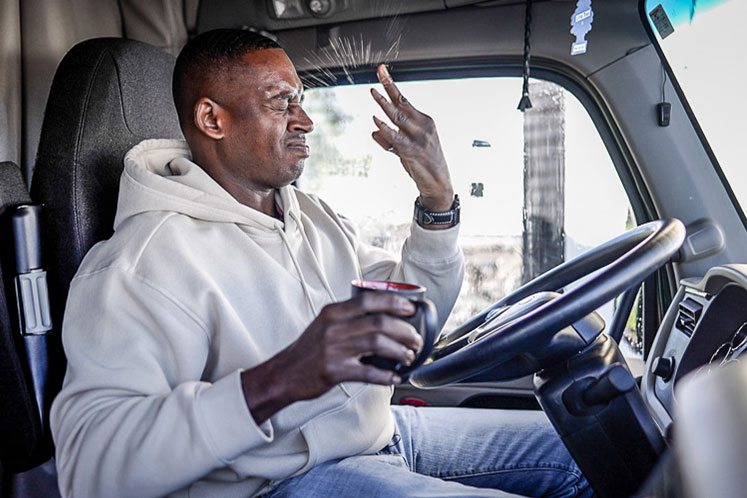
One of the major pitfalls that many drivers fall into is the delusion that they are capable of “pushing through” microsleep. The thought of “I can do this” solidifies in their psyche due to the years of driving practice, caffeine utilization, loud music, or airflow from vents set to cold. Alas, these methods while they may provide temporary stimulation, they don’t re-establish the previous state of freshness.
Microsleep is a situation that the brain faces not as a deficiency in stimulation, but rather, as an imperative for rest. The act of trying to stay awake without dealing with the issues of sleep deprivation brings about a higher frequency of these poses events where each event increases in duration and recovery takes more time.
This is why combating microsleep requires rest-based action, not louder music or more airflow to keep eyes open.
When the signs of warning emerge, the probability of getting sleep attack increases significantly between the next 10 and 20 minutes. In a high tempo situation, this amounts to hundreds of feet traveled in a daze because of only one second of lost awareness.
Checklist Part 1: Spotted Since Microsleep Starting to Form
The starting point for dealing with microsleep is brutal honesty and the genuine will to perform the job well. Drivers need to learn how to detect early signals and also should stop minimizing them.
Before you decide to continue the drive you should ask yourself:
-Might I be rereading road signs or missing exits?
-Do my eyes feel heavy or dry despite blinking?
-Am I struggling to maintain driving alertness?
-Have I experienced any nodding or head drops?
-Do I feel mentally detached from traffic flow?
If you notice warning signs like heavy eyelids or nodding head, treat it as a drowsy driving hazard that requires immediate action.
If your answer to any of the above is “yes”, then the risk of microsleep is already present. Ignoring these signs of problems does not grant you the resilience to handle them, on the contrary, it increases your risk to them.
Checklist Part 2: Steps to Take as Soon as the Signs are Detected
The process of taking immediate action is very important after detecting any microsleep symptoms. Any delays could become fatal.
The effective response goes as follows:
Acknowledge the risk
Denial is self-defeating. You need to accept that your stay awake is no longer guaranteed.
Reduced speed immediately
A slower speed will increase the time needed for a reaction, so in the case of control loss, there will be lower damage.
Signal and prepare to exit traffic Find out the nearest stopover area along the way. Stop driving once it’s safe
Continuing a trip “for just a few miles more” usually is the most common pre-crash decision.
Don’t rely on caffeine alone . Caffeine will not stop microsleep once sleep deprivation is long-term.
When warning signs appear, the goal is not staying awake for longer — it is stopping the risk before a brief episode of sleep happens at speed.
These actions are air defense maneuvers instead of safe-driving suggestions — They are direct preventative actions against the loss of conscious control.
Correct vs Incorrect Reaction to Microsleep
| Situation | Incorrect Reaction | Correct Action |
| Heavy eyelids | Coffee only | Stop and rest |
| Lane drift | “Just one mile” | Immediate pull-over |
| Nodding head | Cold air | End driving |
| Mental fog | Ignore | Power nap |
Top 5 tips on how to stay alert as a truck driver while driving
Checklist Part 3: Break Rules That Work
Not all breaks are the same. A break that does not cut sleep initiation is unsuitable.
To prevent microsleep, breaks must adhere to few rules:
Duration is important
-10-minutes of walking may take any stiffness away but will not fix the problems of too much sleepiness. A break of at least 20 minutes is needed and a restful nap is usually the most efficient way.
Environment
Resting is of no use when you are in a cab buzzing with noise and have frequent interruptions that indicate sleep quality is compromised. A dark and quiet room improves recovery rates tremendously.
Timing is of essence.
Breaks taken when the symptoms are extreme are not as effective as those taken when just the first signs show.
Combating microsleep is most effective when breaks happen at the first warning signs, not after drowsy driving is already severe.
A power nap of 20 to 40 minutes is among the best remedies for restoring driving alertness. Longer naps should be avoided unless the driver is parked for a longer time, as they can lead to sleep inertia.
Why the Fraction of Good Quality Sleep Wins the Battle on Quantity
Many drivers note the hours of sleep they get but disregard the quality of those hours. Interrupted sleep, frequent disturbances, poor sleep conditions, and erratic schedules all lower the value of sleep.
Quality sleep entails:
- Asconsistent as possible sleep times
- A dark, cool, and quiet sleeping space
- Eating no heavy meals immediately before sleep
- Limiting screen exposure before sleep
Drivers who struggle with daytime sleepiness even after sleeping for a whole night should consider the fact that they might have some sleep disorders, such as sleep apnea. If those conditions are untreated, they increase the risk of microsleeping irrespective of adherence to rules or previous experience.
Microsleep and Their Long-term After Math
Microsleep is not just a short-term driving risk. It often signifies an underlying health problem linked to chronic sleep deprivation.
The repeated episodes are associated with:
- Planner errors
- Lower cognitive performance
- Fatigue
- Emotional symptoms
- Raising the risk of future accidents
Drivers who regularly encounter these symptoms of microsleep are not inferior and unworthy but rather are individuals that should operate under physiological conditions that allow adjustment instead of punishment.
The Role of Dispatchers and Scheduling
Microsleep is a driver’s nemesis, but it is also a dispatcher planning failure.
The schedules that permit unrealistic driving time with not the right rest breaks planned are the main cause of increased microsleep risk. Open dialogue between drivers and dispatchers is a key factor. Reporting excessive daytime sleepiness earlier should be issued as a safety alarm signal and not as a performance failure.
Final Checklist: Battle the Microsleep at the Wheel
Before driving ensure that:
You evaluate your sleep quality, not only the hours slept
Early symptoms are looked for
Good rest plans are arranged in advance
During the trip:
Care for the eyelids, focus, and lane
As soon as the symptoms arise, respond
Don’t rely on stimulation tactics
If you are fighting to keep eyes open, treat it as drowsy driving and end the exposure by stopping safely and taking a restorative break.
During breaks:
- You take restorative naps
- Good sleeping conditions are prioritized
- You only restart driving when your call goes back to normal
Final Notes
Tired Truck Drivers Cause Fatal Crashes | Why Trucking Companies Ignore Sleep Laws

Microsleep is by no means a sign of weakness — it is a biological shutting down of the system caused by the lack of sleep and extreme sleepiness. For truck drivers, the most dangerous mistake would be ignoring the symptoms of it.
The objective is not just to remain awake but also to remain attuned or alert. So, identifying the symptoms of microsleep in advance, taking strong measures, and abiding by the efficient break rules not only save other lives but also yours – that is what your actions bring about.