
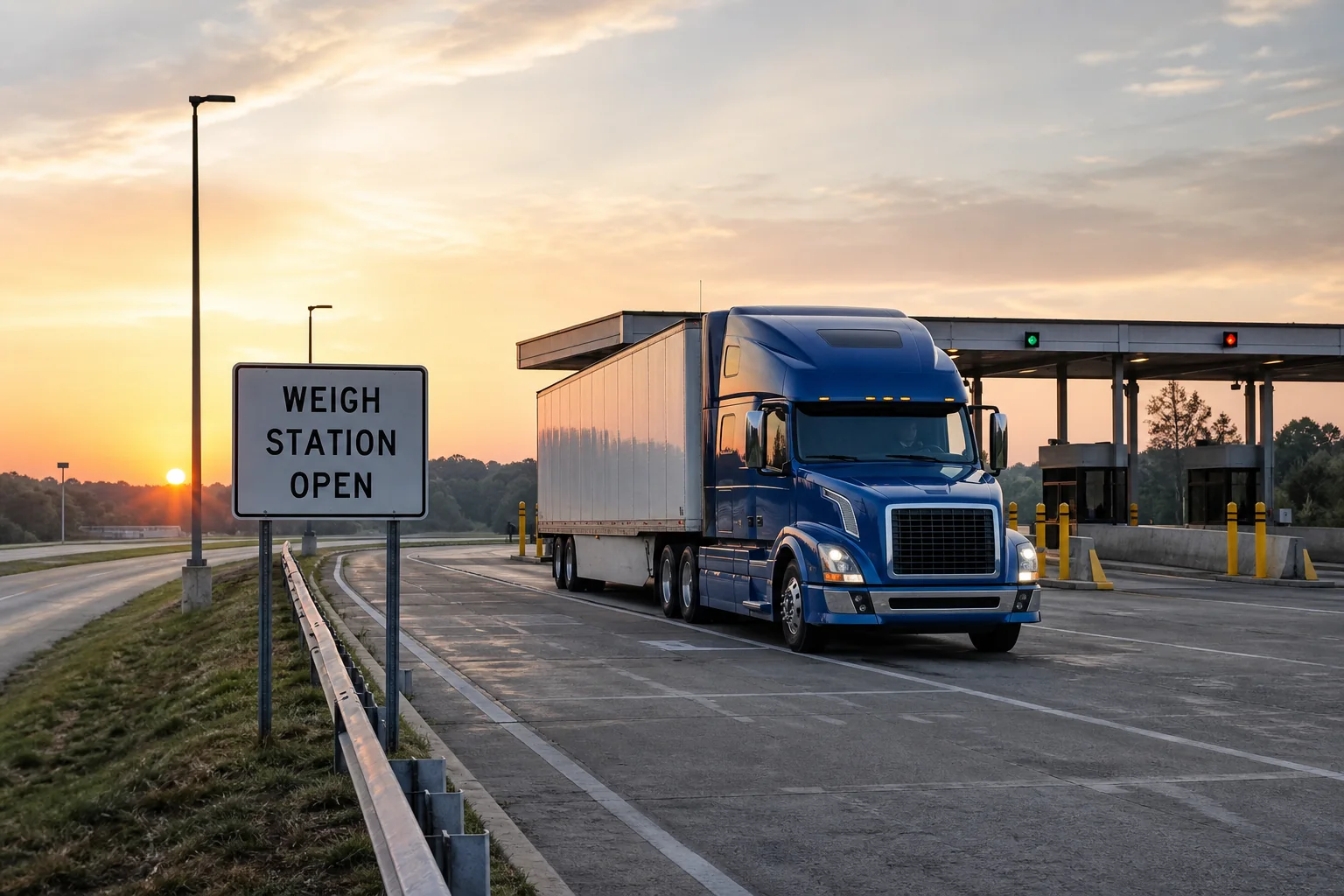
If you are new to professional trucking in the United States, weigh stations are something you will quickly become familiar with. You may see a sign several miles before the facility telling commercial vehicles to prepare to exit, followed by another sign showing whether the station is OPEN or CLOSED.
For experienced truck drivers, passing a weigh station is a normal part of the job. For a new CDL driver, however, the first few visits can be stressful. You may wonder whether you are required to stop, what happens after you enter, whether the truck will be inspected, and what happens if one of your axles is overweight.
A weigh station is much more than a large truck scale. These facilities are used by state enforcement agencies to check commercial vehicles for compliance with weight, size, safety, licensing, registration, and other transportation requirements. Some trucks may move through in less than a minute, while others may be directed to a parking area for a more detailed inspection.
Understanding how weigh stations work can make your first trips much easier and help you avoid preventable violations.
What Is a Weigh Station?
A weigh station is a highway facility where commercial vehicles can be weighed and inspected by state transportation or law-enforcement authorities. Depending on the state, you may also hear these facilities called truck scales, inspection stations, commercial vehicle enforcement facilities, or ports of entry.
One of their primary purposes is making sure trucks do not exceed legal weight limits. Heavy commercial vehicles place significant loads on highways and bridges, and improperly distributed or excessive weight can increase stress on transportation infrastructure. Weight limits also matter for vehicle handling, braking, tire loading, and overall safety.
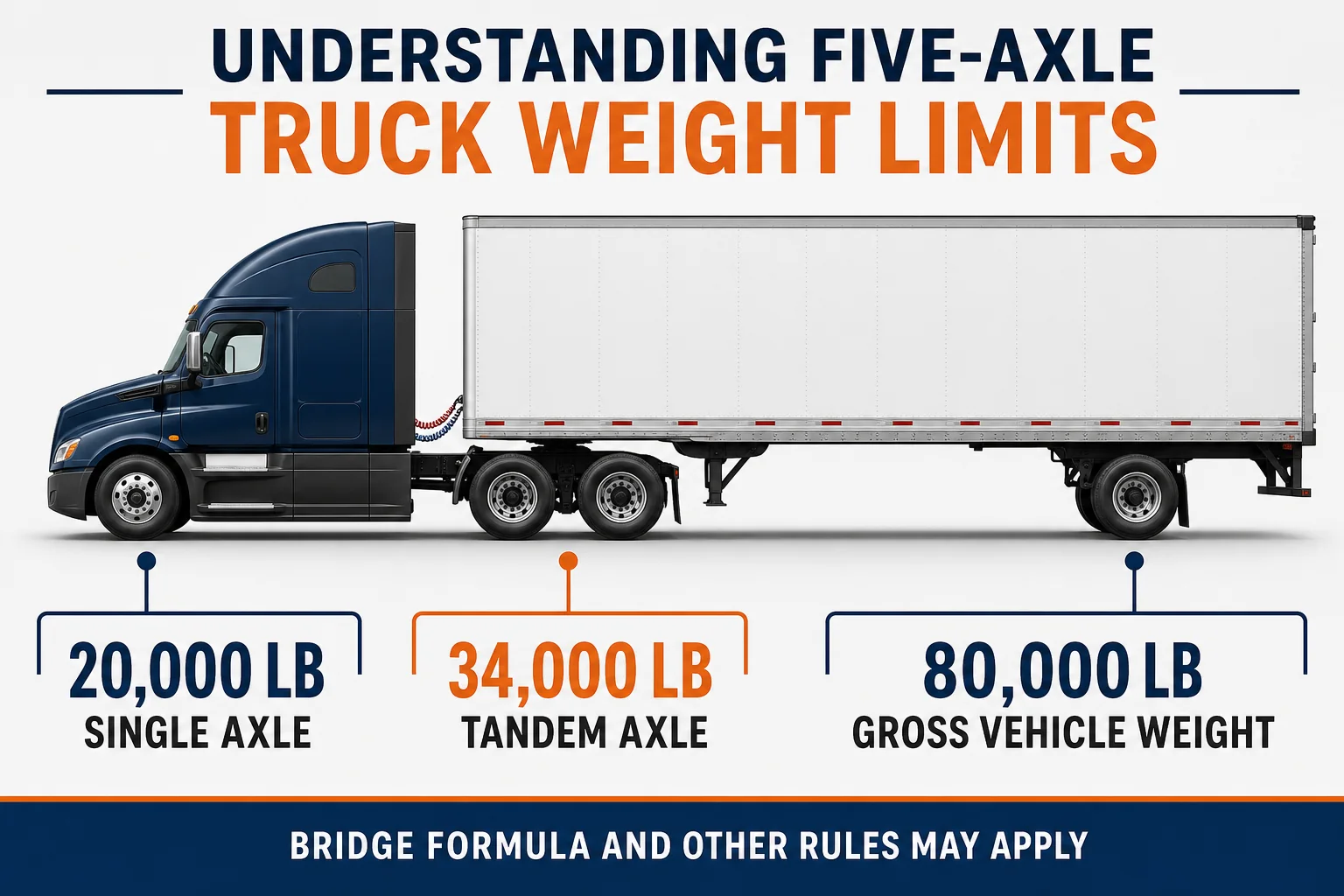
The Federal Highway Administration establishes major weight standards for vehicles operating on the Interstate Highway System. Under the general federal limits, maximum weight is 20,000 pounds on a single axle, 34,000 pounds on a tandem axle, and 80,000 pounds gross vehicle weight, subject to the Federal Bridge Formula and certain exceptions or grandfathered limits. States may have different rules on roads outside the Interstate System and may issue permits for certain oversize or overweight operations.
But weight is only part of the job performed at these facilities. Commercial vehicle enforcement personnel may also check the truck, trailer, cargo, driver credentials, registration, safety equipment, and other areas of regulatory compliance. California, for example, describes its commercial vehicle inspection specialists as checking weight, size, registration, vehicle condition, loading, required equipment, and driver requirements.
This is why thinking of a weigh station as simply a place where someone checks whether your truck weighs 80,000 pounds is incomplete. It is better to think of it as a commercial vehicle compliance checkpoint.
Why Are Trucks Weighed?
A tractor-trailer can legally carry a large amount of weight, but that weight must be distributed correctly.
Suppose your entire tractor-trailer weighs less than 80,000 pounds. That does not automatically mean the vehicle is legal. One axle or axle group can still be overloaded even though the total gross weight is below the maximum.
For Interstate operations under the general federal standards, a single axle is normally limited to 20,000 pounds and a tandem axle to 34,000 pounds. In addition, the Federal Bridge Formula considers the number of axles and the distance between them. The purpose is to prevent excessive weight from being concentrated over a relatively short portion of a bridge or roadway.
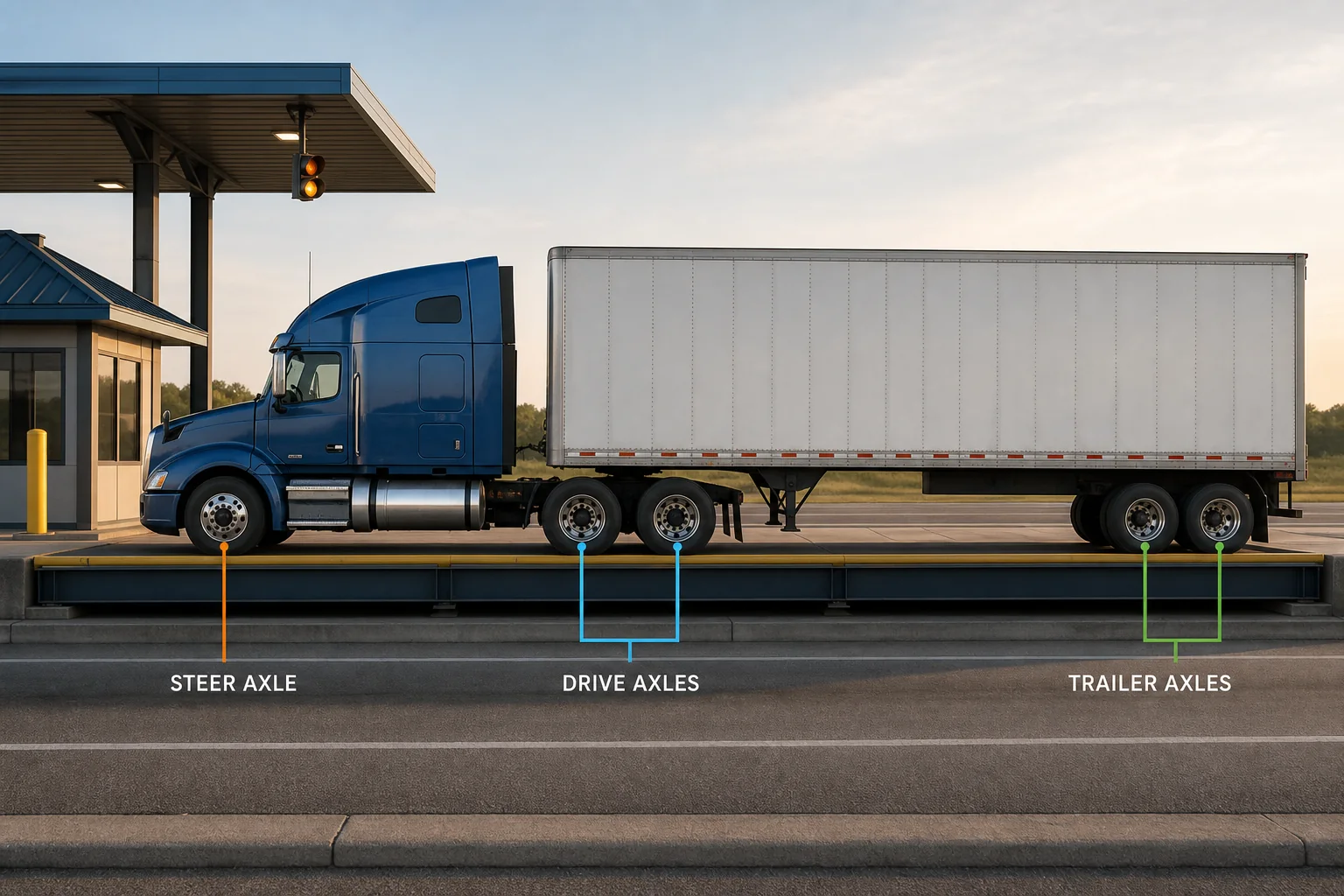
For a typical five-axle tractor-trailer, drivers therefore need to think about more than one number. The steer axle, drive tandems, trailer tandems, gross combination weight, axle spacing, equipment ratings, state rules, and cargo position may all matter.
This is one reason drivers hauling heavy freight often scale their trucks before beginning a long trip. If the load is distributed incorrectly, the driver may be able to correct the problem by moving the trailer tandems or having the freight repositioned before reaching an enforcement scale.
Catching an overweight axle at a truck-stop scale is much easier than discovering it after entering an official weigh station.
What Happens When You Enter a Weigh Station?
The exact process depends on the facility, but entering a weigh station is usually straightforward.
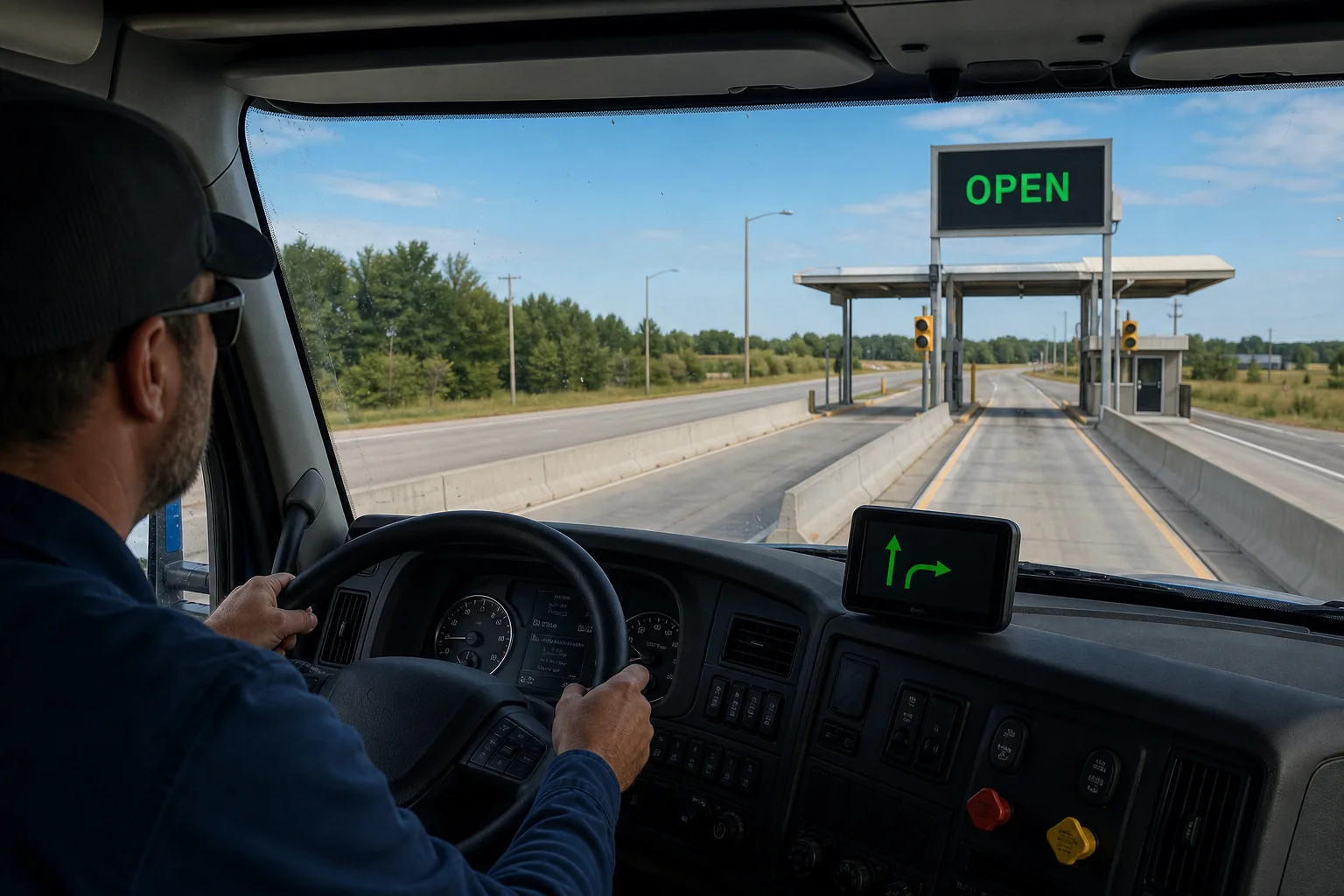
As you approach, watch the highway signs carefully. If the station is open and your vehicle is required to enter, move into the appropriate lane early and safely. Reduce your speed according to the posted limit and pay attention to lane-control lights, signs, electronic displays, and instructions from enforcement personnel.
Some modern facilities use weigh-in-motion technology. Sensors can collect information while a truck is still moving at a controlled speed. This allows enforcement agencies to process large volumes of commercial traffic without requiring every truck to stop completely. California's Cordelia Commercial Vehicle Enforcement Facility, for example, uses weigh-in-motion equipment together with roadside sensors, cameras, and traffic-control systems.
Other facilities use static scales that require the vehicle to move slowly onto a scale platform or stop for an accurate measurement. A driver may be instructed to continue back to the highway immediately if everything appears satisfactory.
If something attracts attention — such as unusual axle weight, an equipment problem, documentation issue, or selection for a routine inspection — the driver may instead be directed to another lane or inspection area.
The important thing is to follow the signs and instructions in front of you rather than guessing. Do not copy the truck ahead of you automatically. That truck may receive different instructions based on its weight, carrier information, bypass status, or inspection selection.
Does Every Truck Have to Stop at Every Weigh Station?
No single rule applies identically to every commercial vehicle in every state.
The requirement to stop depends on factors such as state law, vehicle type, weight, commercial use, cargo, and the wording of the signs at the particular facility. This is why professional drivers should not rely on a simple rule such as "every vehicle over 10,000 pounds always stops everywhere."
Instead, pay attention to the signs as you approach the station and know the rules in the states where you operate.
California demonstrates how state-specific the rules can be. The California Highway Patrol states that commercial vehicles must stop at inspection locations when signs require them to do so, and particular facilities publish their own guidance about which vehicles must enter.
A truck driver operating across several states should therefore become familiar with each state's requirements. Company safety departments, state transportation agencies, official CDL materials, and current commercial-vehicle regulations are better sources than assuming the rule is the same everywhere.
When you see an open weigh station and are uncertain whether your vehicle is required to enter, do not simply drive past because you saw another vehicle continue on the highway.
Missing a required scale can create a much bigger problem than taking a few minutes to enter.
What Do Officers Check at a Weigh Station?
Weight is often the first thing drivers think about, but enforcement personnel can look at much more.
A commercial vehicle inspection may involve the tractor, trailer, driver, paperwork, cargo, and operating credentials. Inspectors may look for visible mechanical defects involving tires, wheels, brakes, lights, suspension, coupling equipment, or other safety-critical systems. Registration and operating information can also be reviewed, along with applicable driver documentation.
Hours-of-Service compliance may also become relevant during a commercial vehicle inspection. Drivers operating under federal HOS requirements need accurate records of duty status, generally maintained through an Electronic Logging Device when the ELD rule applies.
Cargo can matter as well. A truck may be within the overall legal weight limit but still have a loading or securement issue. Flatbed loads, specialized freight, hazardous materials, and other operations can bring additional requirements.
Some weigh stations have dedicated inspection bays where enforcement personnel can perform much more detailed checks. California's Gilroy Commercial Vehicle Enforcement Facility, for example, reports operating seven inspection bays as well as static weight scales for commercial vehicle enforcement.
A driver should therefore approach every scale with the assumption that the truck could be inspected, even if most trips through weigh stations are relatively quick.
What Is a DOT Inspection?
Truck drivers often use the phrase DOT inspection to describe roadside commercial vehicle safety inspections, although federal and state inspectors may conduct different levels and types of inspections.
Depending on the inspection, the officer may focus on the driver, the vehicle, or both. A detailed inspection can involve brake systems, tires, lights, suspension, steering, coupling devices, cargo securement, driver credentials, Hours-of-Service records, and other safety-related items.
Not every truck entering a weigh station receives a complete inspection. Enforcement agencies process large numbers of vehicles, so some trucks are simply weighed and released while others are selected for closer examination.
FMCSA maintains national roadside inspection data that includes both federal and state inspections and tracks inspections according to inspection level.
For the driver, the practical lesson is simple: a good pre-trip inspection matters even when you are not expecting to be inspected. You rarely know in advance when your truck will be selected.
A damaged tire, nonworking light, air leak, brake problem, or other defect that you ignored at the beginning of the day may become much more important when an inspector notices it.
What Happens if Your Truck Is Overweight?
The consequences of an overweight truck depend on the amount and type of violation, the state, the road, permits, and the specific circumstances.
An overweight condition might involve the gross vehicle weight, an individual axle, an axle group, or a violation of the Bridge Formula. A truck could therefore weigh less than 80,000 pounds overall and still have a problem because too much cargo is concentrated over the drive or trailer tandems.
Enforcement consequences can include fines or citations, but the immediate operational problem may be more important to the driver: the truck may need to be made legal before it can continue.
Depending on the load and situation, that can mean adjusting the trailer tandems, moving a sliding fifth wheel where appropriate, redistributing freight, removing part of the load, or obtaining the necessary permit when the operation legally qualifies for one.
Oversize and overweight permit systems are generally administered by the states. FHWA notes that certain vehicles and loads may operate above normal federal limits when properly permitted under applicable state law.
The best strategy is obviously to discover the problem before reaching an enforcement station. If you are hauling a heavy load and are uncertain about axle weights, use an appropriate truck scale after loading.
Why Can a Truck Be Under 80,000 Pounds and Still Be Overweight?
This is one of the most important concepts for new drivers to understand.
Imagine a tractor-trailer with a gross weight of 78,500 pounds. A new driver may look at that number and assume everything is legal because it is below 80,000 pounds.
But suppose too much of the freight is positioned toward the front of the trailer, causing the drive tandems to carry more weight than allowed. The truck can still have an axle violation.
The opposite can happen if too much weight is concentrated toward the rear of the trailer and overloads the trailer tandems.
The Federal Bridge Formula adds another layer because legal weight also depends on axle spacing. Federal rules use the formula to reduce excessive load concentration on bridges, so simply adding individual axle maximums does not always tell you whether a particular axle configuration is legal.
This is why understanding weight distribution is a basic trucking skill.
Experienced drivers do not ask only, "Am I under 80,000?"
They ask, "Are my gross weight, axle weights, axle spacing, and equipment all legal for this route?"
What Is a CAT Scale and How Is It Different From a Weigh Station?
New drivers sometimes confuse a commercial truck scale at a truck stop with an official government weigh station.
They are not the same thing.
A public truck scale such as a CAT Scale is primarily a tool that drivers and carriers use to determine vehicle and axle weights. Drivers often scale a loaded truck before continuing a trip so they can confirm that weight is distributed properly.
An official highway weigh station, by contrast, is an enforcement facility operated by a government agency. Its purpose includes determining whether commercial vehicles comply with applicable laws and regulations.
In practical terms, the truck-stop scale is where you want to discover the problem.
The weigh station is where you do not want to discover it.
For example, after picking up a heavy dry-van load, a driver may go to a nearby truck-stop scale and check the steer, drives, trailer tandems, and gross weight. If the trailer tandems are too heavy, the driver may be able to slide them and weigh the truck again before entering the Interstate.
For new drivers, learning how to read a scale ticket and understand what adjustments will move weight between axle groups is an extremely useful skill.
What Is Weigh-in-Motion?
Traditional scales require a vehicle to stop or move very slowly across a scale platform.
Weigh-in-motion, often abbreviated WIM, uses sensors installed in or near the roadway to estimate or measure vehicle weights while trucks continue moving through a controlled lane.
These systems can help enforcement agencies process commercial traffic more efficiently. Instead of stopping every truck, technology can help identify vehicles that may need additional screening.
FHWA materials note that weigh-in-motion capability can reduce delays and enable more targeted commercial-vehicle checking.
Modern facilities may combine WIM with cameras, vehicle identification systems, electronic screening, and other technologies.
From the driver's perspective, this means a weigh station does not always involve stopping on a traditional platform scale. You may simply reduce speed, pass through the designated lane, receive an electronic or visual instruction, and return to the highway.
What Are PrePass and Drivewyze?
Some carriers use electronic screening and weigh-station bypass systems such as PrePass or Drivewyze.
These systems can allow eligible trucks to receive instructions indicating whether they may bypass certain participating weigh stations or need to enter. They can save time and fuel because a qualified truck may not have to physically enter every participating facility.
However, a bypass service is not permission to ignore weigh-station signs.
The driver must follow the actual instruction provided by the approved system and any applicable road signs or enforcement directions. Bypass eligibility may depend on the carrier, safety history, vehicle, facility, jurisdiction, and other factors.
If your device tells you to enter, enter.
If you do not receive a valid bypass instruction and the signs require your vehicle to stop, follow the signs.
New drivers should learn how their carrier's bypass equipment works during orientation rather than trying to figure it out while approaching a scale at highway speed.
Should You Slow Down Before a Weigh Station?
Yes. Begin preparing before reaching the exit rather than waiting until the last second.
Commercial vehicle enforcement facilities often have significantly lower speed limits than the highway. Some facilities use different lanes for loaded and empty vehicles, and others may direct trucks using signs, arrows, traffic lights, or electronic messages.
For example, CHP's Rainbow Commercial Vehicle Enforcement Facility instructs drivers to obey posted signs and signals and currently lists very low lane speeds for vehicles passing through the facility.
The exact number is not universal, so follow the limit posted at the station you are entering.
Do not enter the scale lane at highway speed and brake aggressively at the last moment. You may have other trucks ahead of you moving slowly or stopping completely.
How Should a New Driver Prepare for Weigh Stations?
The easiest way to reduce weigh-station stress is to operate as though you could be inspected at any time.
Before leaving with a load, perform a complete pre-trip inspection and correct obvious defects. If the shipment is heavy, know your axle weights before beginning the main part of the trip. Make sure the cargo is properly positioned and secured, and verify that required documents and operating information are available.
You should also know how to use your ELD, understand the basic weight limits applicable to your operation, and know how sliding trailer tandems affects weight distribution.
During trip planning, pay attention to weigh stations along the route. Truck-specific navigation systems can identify many locations, but road signs and official instructions take priority over an app.
As you approach an open facility, stay calm, reduce speed, read every sign, and follow the lane assigned to you.
Most importantly, do not panic simply because an officer directs you toward an inspection area. Commercial vehicle inspections are a normal part of trucking. Stay professional, follow instructions, and provide the required information.
Common Mistakes New Drivers Make at Weigh Stations
One of the most serious mistakes is simply passing an open weigh station when the vehicle is required to enter. Drivers may become distracted, follow another truck, misunderstand a bypass device, or assume that an empty trailer means they do not need to stop. Requirements vary, so always read the signs and follow the rules for the jurisdiction.
Another mistake is arriving with a load that has never been scaled. With light freight this may not matter, but with a heavy shipment you should not simply trust that the shipper loaded everything correctly. The driver and carrier still have responsibilities related to the safe and legal operation of the vehicle.
New drivers also sometimes focus entirely on weight and forget that weigh stations can include safety inspections. A legal scale ticket does not make a damaged tire, defective brake, missing light, or other safety problem disappear.
Finally, do not allow the presence of an enforcement officer to make you rush. Move slowly, listen to instructions, keep your truck under control, and ask for clarification if an officer directly gives you an instruction you do not understand.
Do Empty Trucks Have to Stop?
An empty trailer does not automatically exempt a truck from weigh-station requirements.
Whether the vehicle must enter depends on the laws and signs in the particular state and the type of vehicle being operated. An empty tractor-trailer is still a commercial vehicle, and inspection stations are concerned with more than cargo weight.
A vehicle can have an equipment, registration, licensing, or safety issue regardless of whether the trailer contains 40,000 pounds of freight or is completely empty.
This is another reason drivers should follow posted instructions instead of making assumptions based only on cargo.
Are Weigh Stations Always Open?
No.
Some facilities operate continuously, while others open and close depending on staffing, traffic, enforcement operations, location, or other factors.
Electronic highway signs usually indicate whether a facility is currently open.
Do not assume a station that was closed yesterday will also be closed today. Likewise, an app showing a scale as closed may contain outdated crowd-sourced information.
The sign you see on the highway is more important than an old report on your phone.
Some states also use mobile enforcement and portable scales, so avoiding fixed weigh stations does not mean a commercial vehicle cannot be inspected elsewhere. California, for example, describes mobile road-enforcement officers equipped to inspect commercial vehicles whose normal routes do not pass fixed scale facilities.
Why Weigh Stations Matter
Drivers sometimes view weigh stations only as an inconvenience because they can interrupt a trip and potentially lead to inspections or delays.
But the broader purpose is to enforce standards that affect both highway infrastructure and road safety.
Weight regulations help control the loads placed on pavement and bridges. Commercial vehicle inspections can identify dangerous mechanical conditions before they contribute to a crash. Enforcement also creates an incentive for carriers and drivers to maintain their equipment, follow loading rules, and keep required credentials current.
For professional drivers, weigh stations are simply part of operating in a regulated industry.
The goal should not be figuring out how to avoid them.
The goal should be operating a truck that you are comfortable taking across a scale or through an inspection at any time.
Frequently Asked Questions About Weigh Stations
What Is the Maximum Legal Weight for a Semi-Truck?
Under the general federal rules for the Interstate Highway System, the maximum gross vehicle weight is 80,000 pounds, with a 20,000-pound single-axle limit and 34,000-pound tandem-axle limit. The Federal Bridge Formula, permits, grandfathered limits, state laws, and specific equipment can affect what is legal in a particular situation.
Does Every Semi-Truck Have to Stop?
Not necessarily at every facility. Requirements vary by jurisdiction and vehicle. Follow state rules, posted signs, and valid electronic bypass instructions.
Can You Be Inspected Even if Your Weight Is Legal?
Yes. Weigh stations can be used for commercial vehicle safety and compliance inspections in addition to weight enforcement.
What Happens if I Miss a Weigh Station?
If your vehicle was required to enter, bypassing the station can result in enforcement action. Do not intentionally continue past a required scale.
Can an Empty Semi Be Required to Enter?
Yes. An empty trailer does not automatically mean the commercial vehicle is exempt from entering.
Can You Be Overweight Even Below 80,000 Pounds?
Yes. An individual axle or tandem can exceed its allowable weight even when the truck's gross weight is below 80,000 pounds. The Federal Bridge Formula can also affect the allowable weight.
Final Thoughts
A weigh station is a commercial vehicle enforcement facility used to check truck weight and other safety or regulatory requirements.
For new drivers, the idea of entering a weigh station can feel intimidating, but the process becomes routine very quickly. Watch the signs, know whether your vehicle is required to enter, reduce your speed, follow the designated lane, and pay attention to every instruction.
More importantly, prepare before you reach the scale.
Perform a proper pre-trip inspection. Know the condition of your truck and trailer. If you are hauling a heavy load, check your axle and gross weights before getting deep into the trip. Make sure your documents, ELD records, cargo, and equipment are in order.
Remember that 80,000 pounds is not the only number that matters. Axle weights, axle spacing, Bridge Formula requirements, state laws, permits, and equipment limits can all affect whether a truck is legal.
Weigh stations are not something professional drivers need to fear. They are simply another part of operating a commercial vehicle in the United States.
The best way to make them uneventful is simple: run legal, maintain your equipment, know your weights, and follow the signs.